About 238 minutes
Armenia and the Armenians: A List of References in the New York Public Library — Inside the Classic
Fantasy Juvenile Worlds
54,558 recorded words. 8 minutes difference from this book's estimate.
View Gutenberg source #52371
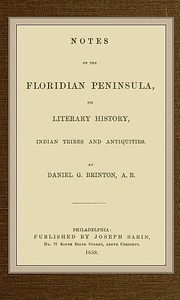
Before opening Notes on the Floridian Peninsula; Its Literary History, Indian Tribes and Antiquities — Context and Discussion, the edition data offers a quick orientation: 56,414 words, 4 hr 6 min estimated reading time, and 10 detected text sections.
The text analysis averages about 22.0 words per sentence, while the detected sections provide another way to judge how the source is divided.
Project Gutenberg metadata also associates the work with “Florida -- History,” connecting these edition facts with the source record’s subject description.
Explore this collection
These alternatives are selected using recorded categories and estimated reading time.
About 238 minutes
Fantasy Juvenile Worlds
54,558 recorded words. 8 minutes difference from this book's estimate.
View Gutenberg source #52371About 238 minutes
Fantasy Juvenile Worlds
54,643 recorded words. 8 minutes difference from this book's estimate.
View Gutenberg source #60814About 218 minutes
Fantasy Juvenile Worlds
50,054 recorded words. 28 minutes difference from this book's estimate.
View Gutenberg source #71466Search stored excerpts and compare books → Choose by your preferences →
Choices use stored catalog measurements. Estimates vary with reading speed. A shared category is a catalog label, not a claim that two books have the same argument or literary quality.
Search reads excerpt text stored with this catalog and links to its associated Gutenberg record. The connection is stored in the site database; this tool does not recheck that every excerpt is word-for-word identical to that external record. Excerpt search does not cover every chapter and does not verify historical publication dates.
Catalog snapshot checked: 2026-09-25. Coverage: 92 public books, 92 available source excerpts.
Read the complete public-domain text at its original source.
Read on Project GutenbergDaniel G. Brinton's Notes on the Floridian Peninsula (1859) moves deliberately between literary history, tribal ethnography, and antiquarian description, a structure that mirrors the layered nature of its subject. The work opens with a preface grounding its observations in a personal visit undertaken for health in 1856–57, then proceeds through chapters that trace European exploration, detail specific tribes like the Apalaches, and examine social customs, religion, and language. This arrangement allows Brinton to juxtapose early colonial narratives with later ethnographic data, creating a composite portrait of Florida's indigenous cultures.
Throughout the excerpts, Brinton returns to two motifs: human sacrifice and the veneration of serpents. He notes that the Caloosas chief annually immolated a person, usually a Christian, as a propitiary offering to the principle of evil, a practice marked on De L’Isle's map as “Les Carlos Antropophages.” Around the St. Johns River, the firstborn son was sacrificed by blows on the head, though Brinton qualifies this as probably limited in observance. The serpent appears as a sacred creature: when a soldier of De Gourgues killed one, natives cut off its head and carried it away “with great care and respect.” Brinton connects this to later Seminole superstitions, tracing a continuity of belief across centuries.
Brinton devotes sustained attention to the priestly class, whose generic appellation javas (with numerous orthographic variants) he derives from the exclamation “yah-wah.” He explicitly rejects Hebrew etymologies proposed by Adair and Boudinot, instead arguing it springs from the natural utterance of the infant. These priests united the roles of physician, sorcerer, and ritual leader: they carried bags of herbs, worked cures for venereal disease, claimed power to command rain, foretell battles, and restore lost objects. When healing failed, they offered spiritual consolation. Brinton’s analysis moves from etymology to function, showing how the priest’s authority permeated daily life.
Brinton describes varied burial practices along the St. Johns River. Upon a chief’s death, the corpse was interred, a mound raised two or three feet high, arrows fixed in the ground around it, and the chief’s drinking conch (le hanap) placed on top. The tribe fasted and mourned for three days and nights, and for six moons women bewailed him thrice daily at sunrise, midday, and sunset. All his possessions were burned in his dwelling, a custom Brinton attributes to a superstitious fear of using the dead’s chattels. These details recur in later sections, reinforcing the theme of ritualized responses to death.
Brinton’s structure constantly shifts between sixteenth-century sources—such as De Soto’s landing, De Gourgues’s campaign, and French colonial records—and his own nineteenth-century observations or those of later writers like Adair and Klemm. For instance, he cites the image of a wooden bird seen at De Soto’s first landing as a symbol rather than an idol, then contrasts it with the absence of idols in Florida. He also moves from early Spanish missions to later Seminole practices, creating a temporal arc. This method allows him to test earlier claims against later evidence, as when he modifies assertions about human sacrifice or serpent veneration.
Readers will find that Brinton’s work rewards attention to its layered structure: each chapter builds on earlier ones, and recurring images—sacrifice, serpents, priestly power—weave through the text. The book is best approached not as a continuous narrative but as a series of linked investigations, where the movement between centuries and sources is itself part of the argument. Brinton’s careful qualification of incomplete evidence reminds us that his conclusions are provisional, grounded in the fragments available to a mid-nineteenth-century scholar.
Brinton’s catalog of tribal rituals reminded me of sitting on my grandfather’s porch, flipping through his old government pamphlets—the way each page carried a quiet, patient weight. That same feeling returned when I later opened the Manual of Style Governing Composition and Proof Reading in the Government Printing Office — Background and Themes, where even punctuation felt like a small ceremony. Both books asked for reverence, not speed.
Answer a few questions and save a private reflection on this device.









