About 238 minutes
Armenia and the Armenians: A List of References in the New York Public Library — Inside the Classic
Fantasy Juvenile Worlds
54,558 recorded words. 20 minutes difference from this book's estimate.
View Gutenberg source #52371
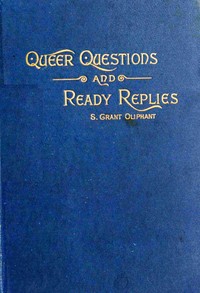
For Queer questions and ready replies — Context and Discussion, the stored edition analysis reports 50,054 words, 3 hr 38 min estimated reading time, and 9 detected text sections.
The text analysis averages about 19.5 words per sentence, while the detected sections provide another way to judge how the source is divided.
Project Gutenberg metadata also associates the work with “Encyclopedias and dictionaries,” connecting these edition facts with the source record’s subject description.
Explore this collection
These alternatives are selected using recorded categories and estimated reading time.
About 238 minutes
Fantasy Juvenile Worlds
54,558 recorded words. 20 minutes difference from this book's estimate.
View Gutenberg source #52371About 238 minutes
Fantasy Juvenile Worlds
54,643 recorded words. 20 minutes difference from this book's estimate.
View Gutenberg source #60814About 246 minutes
Fantasy Juvenile Worlds
56,414 recorded words. 28 minutes difference from this book's estimate.
View Gutenberg source #55068Search stored excerpts and compare books → Choose by your preferences →
Choices use stored catalog measurements. Estimates vary with reading speed. A shared category is a catalog label, not a claim that two books have the same argument or literary quality.
Search reads excerpt text stored with this catalog and links to its associated Gutenberg record. The connection is stored in the site database; this tool does not recheck that every excerpt is word-for-word identical to that external record. Excerpt search does not cover every chapter and does not verify historical publication dates.
Catalog snapshot checked: 2026-09-25. Coverage: 92 public books, 92 available source excerpts.
Read the complete public-domain text at its original source.
Read on Project GutenbergThe work is organized as a sequence of numbered questions followed by answers, a structure that invites browsing rather than linear reading. The preface states the design is to offer 'quaint and curious as well as interesting and instructive information' and to correct popular fallacies. Each entry is self-contained, typically one to three paragraphs, allowing the reader to dip in at any point.
The range of subjects is broad, from 'Ancient city that perished through silence' to 'Author of Greenbacks.' The answers often include anecdotes or historical context, as in the explanation of the 'Blue Hen State' nickname, which traces back to Captain Caldwell's fondness for cock-fighting and the substitution of 'Blue Hen's Chickens' for 'game-cocks.'
The table of contents groups entries under headings like 'Acting Vice-Presidents' and 'Balm of Gilead,' but the sequence within the book does not follow a strict thematic order. Instead, questions on history, geography, and biography intermingle, creating a rhythm of shifting topics. For example, entry 195 asks 'Which is the “Blue Hen State”?' (Delaware), followed by 196 on 'The Dark and Bloody Ground' (Kentucky), then 197 on the author of 'Greenbacks' (Salmon P. Chase). This juxtaposition of state nicknames with financial history reflects the work's encyclopedic ambition.
The movement from one category to another is abrupt, with no transitional text. The reader moves from mythology to natural history to philology without warning. This structure emphasizes the work as a reference tool rather than a narrative, encouraging random access. The preface notes that the information is 'not generally known, even by intelligent and educated readers,' suggesting the author intended to surprise and inform through variety.
Several entries return to the imagery of battle and conflict. The 'battle above the clouds' on Lookout Mountain is described with a 'dense fog hung like a hood' and soldiers 'swept over the crest.' The 'Dark and Bloody Ground' entry refers to 'dark and bloody conflicts' between settlers and Native Americans, and between Northern and Southern Indians. The 'Blue Hen State' origin involves cock-fighting, a violent sport, and the regiment's 'daring and undaunted spirit.'
Origin stories also recur: the naming of John Quincy Adams is traced to his great-grandfather, with a quote from Adams himself about 'filial tenderness.' The founding of Georgia as a 'home for the poor' is attributed to James Oglethorpe's benevolence. These entries share a pattern of explaining how a name or place came to be, often with a moral or sentimental gloss.
Oliphant's answers often include direct quotations or citations, as in the John Quincy Adams entry where Adams' own words are given. The preface claims 'care has been taken that no statement should be made which cannot be supported by good authority.' This evidentiary stance is visible in entries like the 'battle above the clouds,' where Grant's reported dismissal of the battle as 'all poetry' is included, adding a layer of skepticism.
The tone is factual but occasionally wry. The 'Blue Hen State' explanation includes the detail that Caldwell insisted 'no cock could be truly game unless the mother was a blue hen,' a specific and slightly humorous claim. The work's subtitle promises 'ready replies,' and the answers are indeed concise, often ending with a clear resolution. The authorial voice is that of a compiler who values precision and curiosity.
The book is divided into 400 numbered entries, each with a question and answer. The table of contents lists entries alphabetically by key phrase (e.g., 'A' for 'Acting Vice-Presidents'), but the body follows numerical order. This dual organization—alphabetical index and sequential reading—allows multiple access points. The preface positions the work as a 'convenient form' for the 'reading public,' implying it is meant for casual consultation rather than systematic study.
The entries vary in length from a single sentence to several paragraphs. The 'battle above the clouds' entry is relatively long, with narrative detail, while others like 'Ancient city that perished through silence' are brief. This variation suggests the author prioritized interest over uniformity. The work's fourth edition indicates it found an audience, and the structure supports repeated browsing.
Readers approaching this work will find it best used as a dip-in resource rather than a cover-to-cover read. The entries reward curiosity about odd facts and historical anecdotes. The author's commitment to verifiable statements, combined with the occasional surprising detail, makes the book a period piece of late-19th-century popular education. For those interested in the origins of American place names, political nicknames, or the Civil War, specific entries offer concise, sourced answers.
There’s something almost comforting about that old reference book’s quiet certainty, the way it pins down “Blue Hen State” without fuss. It reminds me of how I feel leafing through A bibliography of the writings of D. H. Lawrence — Background and Themes, turning pages that hold a life’s scattered words. Both feel like rooms I’ve visited before, though I can’t say precisely why.
Build a private reading journal entry for this title.









