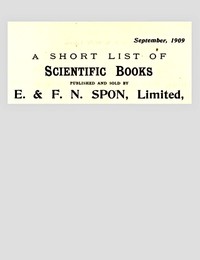
This is not a book but a bookseller's inventory: a 1909 catalogue from the London firm E. & F. N. Spon, listing hundreds of scientific and technical titles. The list is organized by subject—Agriculture, Architecture, Electrical Engineering, Metallurgy, and dozens more—each entry giving author, edition, page count, binding, and price in shillings and pence. The catalogue reveals what a working engineer, chemist, or builder might have consulted a century ago.
The entries are terse and factual: 'Hemp. A Practical Treatise on the Culture of Hemp for Seed and Fibre, with a Sketch of the History and Nature of the Hemp Plant. By S. S. Boyce. 13 illus. 112 pp. crown 8vo. (New York, 1900) net 2 0.' No blurbs, no endorsements—just the data needed to order. Yet the range is striking: alongside steam engines and boilers sit 'Diseases of a Gasolene Automobile' and 'The Stokers’ Catechism.'
A Catalogue as Historical Artifact
The catalogue's structure itself is revealing. It opens with a table of contents listing 52 subject headings, from Agriculture to Workshop Practice, with a final 'Miscellaneous' catch-all. The headings reflect the applied sciences of the era: 'Gas and Oil Engines,' 'Telegraph Codes,' 'Warming; Ventilation.' Many entries are reprints or new editions of works first published decades earlier—'Hops, their Cultivation, Commerce and Uses' from 1877, 'Tropical Agriculture' from 1889—suggesting steady demand for established references.
Prices are given in shillings and pence, with a note that they apply only to the United Kingdom. Some entries are marked 'net,' others not; the difference likely indicates trade discounts. The catalogue also lists sole English agency arrangements for American publishers, including Myron C. Clark, The Business Code Company, and Spon & Chamberlain. This cross-Atlantic pipeline shows how technical knowledge circulated before the digital age.
The Range of Practical Knowledge
The subjects covered are overwhelmingly practical. Under 'Agriculture' we find treatises on hemp, tea, coffee, sugar, hops, cocoa, and estate fences. 'Mechanical Engineering' includes works on mill gearing, safety valves, belt driving, worm gearing, and the Corliss engine. 'Metallurgy' features 'Iron and Steel Manufacture' and 'Life of Railway Axles.' There are also less expected entries: 'Foreign Exchange,' 'Organisation,' and 'Historical; Biographical.'
Many titles are aimed at the working professional or tradesman: 'The Stokers’ Catechism,' 'Fireman’s Guide,' 'How to Run Engines and Boilers.' The format varies from multi-volume folios to slim 18mo pamphlets. A few entries hint at emerging technologies: 'Diseases of a Gasolene Automobile' (1903) and 'Liquid Fuel for Mechanical and Industrial Purposes' (1890). The catalogue thus captures a moment when steam still dominated but internal combustion was gaining ground.
What the Catalogue Omits
For all its breadth, the catalogue is silent on many things. There are no entries for chemistry proper (though 'Industrial Chemistry' appears), no pure physics beyond 'Physics' as a heading, and no biology or geology. The focus is relentlessly on engineering, manufacturing, and applied science. The humanities are absent entirely—no history, literature, or philosophy. This is a tool for builders, not thinkers.
The catalogue also tells us nothing about how these books were used. Were they bought by individuals or institutions? Were they consulted on site or studied at home? The entries give no indication of readership or critical reception. What remains is a skeleton of titles and prices, a snapshot of what was available—and by extension, what was needed—in the technical world of 1909.
This catalogue is best approached not as a reading list but as a primary source for the history of technology and publishing. It documents what knowledge was considered worth printing and selling, and at what cost. For anyone studying the material culture of early twentieth-century science, it offers a concrete baseline: these were the books that engineers, farmers, and builders could actually buy.
There’s something touching about that 1909 Spon catalogue, all those practical promises in neat columns. Six years later, the 1915 edition carries a different weight, knowing what those workshop manuals meant while the world was shifting. I like holding both together—the quiet optimism, then the steadiness. A small, strange comfort in how they kept listing things like A Short List of Scientific Books Published by E. & F. N. Spon, Ltd. September 1915 — Inside the Classic mattered.