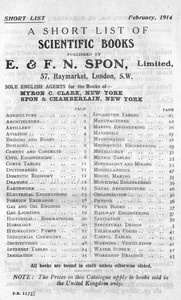
E. & F. N. Spon's February 1914 catalogue presents a dense taxonomy of scientific and technical knowledge, organized into 44 subject sections from Agriculture to Workshop Practice. The list is a practical tool for the professional reader: each entry includes author, title, edition, number of illustrations, page count, format, publication year, and price in shillings. Many titles are described as 'net' prices, indicating fixed pricing in the United Kingdom. The catalogue's voice is brisk and informational, with entries like 'Hemp. A Practical Treatise on the Culture for Seed and Fibre' or 'The Stokers' Catechism'—titles that signal immediate utility.
A Catalogue Built for Browsing
The catalogue's structure mirrors the browsing habits of a technical reader. Sections are alphabetically arranged, but within each, entries follow no strict order—some cluster by topic, others by author. For instance, under 'Mechanical Engineering,' titles range from 'Engineers' Sketch Book of Mechanical Movements' (with 3,000 illustrations) to 'The Stokers' Catechism' (63 pages, limp binding). This variety suggests the publisher catered to both the engineer and the tradesman. The inclusion of 'The Mechanical Engineers' Price Book'—a pocket-sized leather-bound volume—hints at a market for field-ready references. The catalogue's own physical description ('pocket size (6-1/2 in. by 3-3/4 in. by 1/2 in. thick)') mirrors the practical dimensions it promotes.
Pricing and the Promise of Authority
Prices in the catalogue range from 1 shilling for 'The Stokers' Catechism' to £1 5s for 'Sugar, a Handbook for Planters and Refiners.' Many entries note multiple editions: 'Quick and Easy Methods of Calculating' reached a fourth edition by 1912, while 'Arithmetic of Electricity' was in its thirteenth. These repeated editions imply sustained demand and ongoing revision. The catalogue also signals authority through institutional affiliations—'Translated from the French by E. A. O'Keefe' or 'Revised by Major B. R. Ward, R.E.'—and through the inclusion of works by figures like G. S. Ohm. The phrase 'Sole English Agents for the Books of—Myron C. Clark, New York' underscores the transatlantic reach of the firm.
The Catalogue as a Snapshot of Technical Knowledge
The subject headings themselves map the boundaries of early 20th-century technical education. Sections like 'Aviation' (new in 1914), 'Gas and Oil Engines,' and 'Warming: Ventilation' reflect emerging technologies. Others, such 'Curve Tables' and 'Interest Tables,' point to the computational tools of the era. The catalogue includes works on 'Nautical Astronomy' and 'Figure of the Earth' alongside 'Model Making' and 'Telegraph Codes.' This juxtaposition reveals a publishing program that served both the specialist and the hobbyist. The absence of any introductory essay or editorial commentary means the list speaks entirely through its selection and arrangement—a quiet document of what knowledge was deemed marketable a century ago.
Readers approaching this catalogue should note that it is not a reading guide but a primary source. The entries are best examined for what they reveal about the material culture of technical publishing: binding formats, price points, and the geography of knowledge distribution. Pay attention to the frequency of 'New York' imprints and the role of Spon as a sole agent. The catalogue's brevity—16,003 words—belies its density of information; it rewards slow, comparative reading.
I found myself thinking about that odd little 1914 catalogue again—those crisp engineering tables, prices in shillings, a world so sure of itself. There’s something tender in its precision, like a photograph of someone I never knew. Fine Books — A Closer Reading carried the same quiet ache, that gentle sorrow of pages that meant everything once. It stayed with me, softly, the way certain afternoons do.