About 70 minutes
A Short List of Scientific Books Published by E. & F. N. Spon, Limited. February 1914 — Key Ideas to Explore
Science Fiction Utopias
16,003 recorded words. 1 minutes difference from this book's estimate.
View Gutenberg source #58377
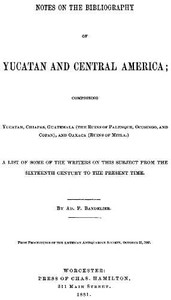
The catalog record for Notes on the Bibliography of Yucatan and Central America Comprising Yucatan, Chiapas, Guatemala (the Ruins of Palenque, Ocosingo, and Copan), and Oaxaca (Ruins of Mitla) — A Reader’s Guide provides practical reading context through 16,169 words, 1 hr 11 min estimated reading time, and 3 detected text sections.
The text analysis averages about 11.0 words per sentence, while the detected sections provide another way to judge how the source is divided.
Project Gutenberg metadata also associates the work with “Mayas -- Antiquities,” connecting these edition facts with the source record’s subject description.
Explore this collection
These alternatives are selected using recorded categories and estimated reading time.
About 70 minutes
Science Fiction Utopias
16,003 recorded words. 1 minutes difference from this book's estimate.
View Gutenberg source #58377About 72 minutes
Science Fiction Utopias
16,519 recorded words. 1 minutes difference from this book's estimate.
View Gutenberg source #58489About 74 minutes
Science Fiction Utopias
16,896 recorded words. 3 minutes difference from this book's estimate.
View Gutenberg source #59453Search stored excerpts and compare books → Choose by your preferences →
Choices use stored catalog measurements. Estimates vary with reading speed. A shared category is a catalog label, not a claim that two books have the same argument or literary quality.
Search reads excerpt text stored with this catalog and links to its associated Gutenberg record. The connection is stored in the site database; this tool does not recheck that every excerpt is word-for-word identical to that external record. Excerpt search does not cover every chapter and does not verify historical publication dates.
Catalog snapshot checked: 2026-09-25. Coverage: 92 public books, 92 available source excerpts.
Read the complete public-domain text at its original source.
Read on Project GutenbergBandelier's bibliography, originally published in the Proceedings of the American Antiquarian Society in 1880, opens with a striking specificity: the earliest European account of Yucatan is a chaplain's report appended to a travel book by Ludovico Varthema. The entry for Juan Diaz notes the Italian original, an English translation by Richard Eden, and a Spanish reprint by Icazbalceta—a chain of transmission that Bandelier traces with meticulous care. This is not a mere list; it is a map of how knowledge about Mesoamerican ruins traveled across languages and centuries.
The first section of Bandelier's work concentrates on writers of the 1500s, beginning with Juan Diaz, chaplain to Juan de Grijalva. Bandelier records the Itinerario in its Italian, English, and Spanish incarnations, noting that the most popular translation was by Ternaux-Compans. He then turns to Petrus Martyr ab Angleria, whose De orbe novo decades contained the first published items on Yucatan after Diaz. Bandelier lists editions from Basel, Alcalá, and Paris, as well as German and English versions, emphasizing that Martyr's work is of “great importance” for the region. The pattern is clear: Bandelier values not just the original text but its entire publication history, treating each reprint and translation as a node in a network of scholarly transmission.
Bandelier gives special attention to unpublished sources, particularly those held in Guatemalan archives. He cites the Libro de Actas del Ayuntamiento de la Ciudad de Guatemala from 1524 to 1530, and a series of Libros de Cabildo covering 1530 to 1543. He also highlights the Memorial of Francisco Hernandez, a native cacique written around 1582, which Bandelier calls “one of the most important and valuable documents existing on aboriginal topics” because it records the conquest of Guatemala in the author's own language. Beyond these, he stresses the value of “territorial titles”—land grants, leases, and deeds—which “contain frequently interesting, if not important references to antiquities, traditions and historical facts.” This emphasis on legal documents as historical sources is a distinctive feature of Bandelier's approach.
Bandelier includes a telling observation about the ruins of Copan. Citing the 1576 report of Palacio, he notes that the buildings were already in ruins at the time of the Spanish conquest, around 1530, and that “no distinct traditions of their origin left” among the local population. This detail, buried in a bibliographic entry, reveals a central tension in the study of Mesoamerican antiquities: the gap between the physical remains and the historical record. Bandelier does not speculate on the cause, but his inclusion of the fact underscores the limits of both archaeology and ethnohistory. The bibliography thus becomes not just a list of sources, but a record of what those sources fail to say.
Bandelier's bibliography is best read as a tool for tracing the movement of texts and the accumulation of knowledge. Readers interested in the intellectual history of Mesoamerican studies will find it a valuable guide to the early modern sources that shaped later archaeological work. The work rewards careful attention to its cross-references and its occasional, pointed observations about the state of the evidence.
That old Bandelier bibliography always felt like a lantern in a dusty archive, illuminating the faint footprints of forgotten chaplains and surveyors. Its careful patience reminds me of another shelf-companion, where the quiet art of timing a punchline is weighed as precisely as any land title. There is a kinship in how both treasure human voice across ages, and the Toaster's Handbook: Jokes, Stories, and Quotations — A Closer Reading holds a similar, gentle light for the spoken word.
A brief reflection can help important ideas stay with you longer.









