About 72 minutes
A Short List of Scientific Books Published by E. & F. N. Spon, Limited. June 1913 — Edition Insights
Science Fiction Utopias
16,519 recorded words. 2 minutes difference from this book's estimate.
View Gutenberg source #58489
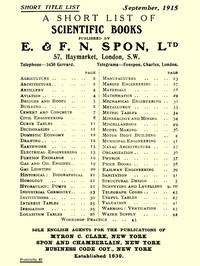
For A Short List of Scientific Books Published by E. & F. N. Spon, Ltd. September 1915 — Inside the Classic, the stored edition analysis reports 16,896 words, 1 hr 14 min estimated reading time, and 46 detected text sections.
The text analysis averages about 5.9 words per sentence, while the detected sections provide another way to judge how the source is divided.
Project Gutenberg metadata also associates the work with “Publishers' catalogs -- England -- London,” connecting these edition facts with the source record’s subject description.
Explore this collection
These alternatives are selected using recorded categories and estimated reading time.
About 72 minutes
Science Fiction Utopias
16,519 recorded words. 2 minutes difference from this book's estimate.
View Gutenberg source #58489About 71 minutes
Science Fiction Utopias
16,169 recorded words. 3 minutes difference from this book's estimate.
View Gutenberg source #40728About 70 minutes
Science Fiction Utopias
16,003 recorded words. 4 minutes difference from this book's estimate.
View Gutenberg source #58377Search stored excerpts and compare books → Choose by your preferences →
Choices use stored catalog measurements. Estimates vary with reading speed. A shared category is a catalog label, not a claim that two books have the same argument or literary quality.
Search reads excerpt text stored with this catalog and links to its associated Gutenberg record. The connection is stored in the site database; this tool does not recheck that every excerpt is word-for-word identical to that external record. Excerpt search does not cover every chapter and does not verify historical publication dates.
Catalog snapshot checked: 2026-09-25. Coverage: 92 public books, 92 available source excerpts.
Read the complete public-domain text at its original source.
Read on Project GutenbergThe catalog opens not with a preface but with a dense table of contents, listing fifty-two subject headings from Agriculture to Workshop Practice. This structure immediately signals that the text prioritizes browsability over narrative. The entries themselves are stripped to essentials: title, author, illustration count, page count, format, publication date, and price. For instance, “Hemp. A Practical Treatise on the Culture for Seed and Fibre. By S. S. Boyce. 13 illus., 112 pp., crown 8vo. (New York, 1912.) 2 s. 6 d. net.” The voice is that of a ledger, not a bookseller’s pitch.
The catalog’s pace is uniform yet varied by the length of entries. Most items occupy a single line, but some, like Steam Engines and Boilers, extend to a full paragraph. The repetition of abbreviations—‘illus.,’ ‘pp.,’ ‘crown 8vo’—creates a staccato rhythm. This pattern is broken only by occasional notes such as “Postage 3 d.” or “Second ed.” The effect is hypnotic: the reader’s eye moves quickly down the page, pausing only at unfamiliar titles or unusually high prices. The catalog does not argue for a book’s value; it simply presents the facts, trusting the reader to decide.
The catalog’s organization by subject imposes a clear hierarchy. Within each section, entries are alphabetical by author, but the sections themselves follow no obvious logic—Agriculture precedes Architecture, which precedes Artillery. This arrangement suggests that the catalog was designed for quick reference rather than thematic flow. A reader interested in Mathematics will find works on imaginary quantities, slide rules, and graphic statics grouped together, but they must navigate through unrelated fields to reach them. The catalog thus mirrors the specialized knowledge it promotes: each discipline is a self-contained world.
Prices recur throughout the catalog, often in shillings and pence, occasionally in pounds. They anchor each entry in a commercial reality. For example, Quick and Easy Methods of Calculating costs 2 s. 6 d. net, while Machine Design is 12 s. 6 d. net. These figures hint at the intended audience: the cheaper works are often pocket-sized or board-bound, suggesting they were aimed at students or practitioners on a budget. The inclusion of “Postage 3 d.” for The Mechanical Engineer’s Price Book adds a layer of practical detail, reminding the reader that this is not a mere bibliography but a sales document.
Readers approaching this catalog should treat it as a period artifact rather than a reading list. The brevity of each entry invites comparison: why does one book merit a second edition while another remains in its first? The catalog’s silences—no reviews, no endorsements—leave such questions open. Pay attention to the dates: many works were published decades before 1915, suggesting that Spon valued enduring references over novelty. The catalog is a snapshot of a publisher’s confidence in its backlist.
That September 1915 list felt like rain on a tin roof—each entry a sharp, metallic tap, engineering beside geology, prices ticking like a metronome. I sat with it until the dull ache of utility became almost musical. Later, leafing through A Short List of Scientific Books Published by E. & F. N. Spon, Limited. February 1914 — Key Ideas to Explore, the earlier catalogue’s austerity softened, as if the year between them had taught me how to listen for the quieter spaces between its lines. Just a small, private pleasure.
Answer a few questions and save a private reflection on this device.









