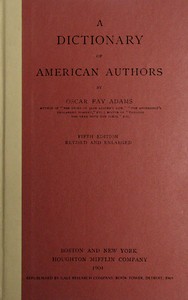
Oscar Fay Adams's A Dictionary of American Authors opens with a preface that traces its lineage to an earlier Handbook of American Authors (1884), establishing the work as an evolving project rather than a static compilation. The fifth edition (1904) includes a supplement extended by sixty-five pages, adding thirteen hundred and twenty names beyond the fourth edition. Adams acknowledges that the dictionary “still falls much short of perfection in its line,” a candid admission that sets the tone for a reference work built on incremental improvement.
Alphabetical Architecture and Entry Structure
Each entry follows a consistent pattern: surname, given name(s), state abbreviation, birth and death years, occupation, and a list of notable works. For example, the entry for James Gates Percival notes his verse “once popular, but now wholly neglected” and specifies that “Seneca Lake and The Coral Grove are still found lingering in anthologies.” Such evaluative remarks are rare; most entries stick to factual data. The dictionary’s reliance on abbreviations—such as “Ap. Cas. Mer. Rob.” for publishers—assumes a literate audience familiar with the period’s literary marketplace.
Gaps and Omissions: The Editor’s Candor
Adams openly addresses missing information. In the preface, he explains that some names were omitted “at the request of their owners,” while others lack data because “diligent search failed to discover any trustworthy data.” Unfilled birth dates or initials remain because “application by letter made directly to the owners… has failed to elicit any response.” This transparency about the limits of his research—and the late arrival of some information after electrotyping—gives the dictionary a human, provisional quality unusual for a reference work.
The Supplement as a Living Document
The fifth edition’s supplement runs 146 pages of addenda across all editions. Adams notes that “throughout the book there have been supplied many dates of deaths happening since the first issue.” This ongoing revision process turns the dictionary into a record of literary mortality as much as a biographical index. The supplement’s growth—from zero to 146 pages over seven years—reflects the rapid expansion of American publishing at the turn of the century, as well as Adams’s commitment to keeping pace with it.
Geographical and Occupational Patterns
Entries consistently include state abbreviations, revealing regional clusters: New York, Massachusetts, Pennsylvania, and Virginia appear frequently. Occupations range from “novelist” and “verse-writer” to “physician,” “jurist,” and “Baptist clergyman.” The dictionary captures a literary ecosystem where clergy and doctors often published alongside professional authors. For instance, Edmund Monroe Pendleton is listed as a physician who wrote Scientific Agriculture, while Charles Clifton Penick, a bishop, authored More than a Prophet. These cross-disciplinary entries broaden the definition of “author” beyond belles-lettres.
Readers approaching A Dictionary of American Authors should treat it as a snapshot of the early-1900s literary landscape, not a comprehensive modern database. The work’s value lies in its period-specific judgments, its acknowledgment of gaps, and its inclusion of minor figures who might otherwise be forgotten. Use the state abbreviations and publisher codes as clues to regional and commercial networks, and note that the supplement often contains the most up-to-date information.
Leafing through Adams’s old dictionary, I kept pausing at names like forgotten porch lights. Each entry held a quiet life, a small universe of text and context. It made me think of that other volume, 1000 Things Worth Knowing — Reading Companion, which felt less like a reference and more like a friend’s marginalia—warm, unhurried, full of the same gentle reverence for what words leave behind.