About 455 minutes
The Handy Cyclopedia of Things Worth Knowing A Manual of Ready Reference — Text and Context
Adventure Picaresque Fiction
104,611 recorded words. 175 minutes difference from this book's estimate.
View Gutenberg source #20190
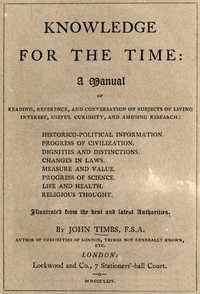
For Knowledge for the Time A Manual of Reading, Reference, and Conversation on Subjects of Living Interest, Useful Curiosity, and Amusing Research — Reading Notes, the stored edition analysis reports 144,820 words, 10 hr 30 min estimated reading time, and 19 detected text sections.
The text analysis averages about 21.9 words per sentence, while the detected sections provide another way to judge how the source is divided.
Project Gutenberg metadata also associates the work with “Encyclopedias and dictionaries,” connecting these edition facts with the source record’s subject description.
Explore this collection
These alternatives are selected using recorded categories and estimated reading time.
About 455 minutes
Adventure Picaresque Fiction
104,611 recorded words. 175 minutes difference from this book's estimate.
View Gutenberg source #20190About 371 minutes
Adventure Picaresque Fiction
85,272 recorded words. 259 minutes difference from this book's estimate.
View Gutenberg source #68873About 358 minutes
Adventure Picaresque Fiction
82,250 recorded words. 272 minutes difference from this book's estimate.
View Gutenberg source #17112Search stored excerpts and compare books → Choose by your preferences →
Choices use stored catalog measurements. Estimates vary with reading speed. A shared category is a catalog label, not a claim that two books have the same argument or literary quality.
Search reads excerpt text stored with this catalog and links to its associated Gutenberg record. The connection is stored in the site database; this tool does not recheck that every excerpt is word-for-word identical to that external record. Excerpt search does not cover every chapter and does not verify historical publication dates.
Catalog snapshot checked: 2026-09-25. Coverage: 92 public books, 92 available source excerpts.
Read the complete public-domain text at its original source.
Read on Project GutenbergJohn Timbs's Knowledge for the Time (1864) is a Victorian miscellany that arranges its contents under classified headings—historico-political information, progress of science, life and health, and religious thought—each drawing on contemporary journalism and expert testimony. The work's structure reflects a deliberate movement from broad topics to granular particulars: a section on coinage, for instance, enumerates sixteen separate operations required to convert an ingot into sovereigns, then pivots to the accelerated wear of silver coins caused by railway travel and cheap fares. This pattern of zooming from general principle to concrete process recurs throughout, giving the book a rhythm of exposition followed by illustration.
One of the most striking passages in the manual details the manufacture of gold sovereigns at the Mint. Timbs lists each step in sequence: the ingot is first melted, then rolled, cut, weighed, blanched in an acid bath, washed in cold water, dried in hot beech-wood saw-dust, muffled, and finally stamped on both sides and milled on the edges. The description emphasizes that the perforated "fillets" left after cutting must be remelted and the entire cycle repeated, so that the sixteen operations are multiplied before the last sovereign is obtained. This attention to mechanical process is typical of the book's method: it treats knowledge as something built from discrete, observable stages rather than abstract principles.
Timbs then shifts to the deterioration of coins, citing experiments from the late eighteenth century and comparing them to current data. Silver coins of the same age now show greater loss: crowns have gone from 3½ to 5 percent, shillings from 24½ to 30 percent, and sixpences from 38.2 to 45 percent. The cause, he writes, is "fast living"—people move about more frequently due to railways, and money moves with them. Gold coinage, by contrast, deteriorates less because it circulates in "higher and more circumscribed circles" and is nursed under the porte-monnaie system. The passage illustrates how Timbs uses statistical evidence to link social change to material objects, a recurring strategy in the volume.
A third section on coinage traces the history of counterfeiting. Timbs notes that the earliest method of making money was pouring fluid bullion into earthen moulds, a technique still used by counterfeiters in the nineteenth century. He observes that the private coiner of his day spends little on plant—a pennyworth of plaster of Paris suffices to make a mould from a genuine coin. The passage draws a direct line from the moneyers of the Heptarchy to modern Birmingham and London forgers, emphasizing continuity in method despite improved appliances. This historical framing is characteristic of the manual's approach: it places contemporary phenomena within a long arc of technical and social change.
Timbs opens the volume with a defense of his method, quoting Dr. Arnold: "Preserve proportion in your reading, keep your views of Men and Things extensive, and depend upon it a mixed knowledge is not a superficial one." The author presents the book as a corrective to the Past by the light of the Present, drawing on "the most reliable views of leading writers on Events of the Day." He acknowledges that truth is not easily acquired and that distance from events rarely improves the chances of obtaining unprejudiced accounts. This framing positions the manual as a tool for contemporary readers to assess the reliability of sources, rather than a mere compendium of facts.
Readers approaching Knowledge for the Time will find a work that rewards browsing as much as systematic study. Timbs's habit of moving from general categories to minute procedures—whether in minting, coin wear, or counterfeiting—invites the reader to observe how knowledge is built from concrete steps. The book's reliance on contemporary journalism and expert testimony also encourages a critical stance toward sources, a theme the author explicitly addresses in his preface. For those interested in Victorian attitudes toward information, progress, and material culture, this manual offers a rich, if episodic, record.
I keep thinking about Timbs’s old manual, how it sat with me long after I closed it—all those tiny, careful details, like coins wearing thin from railway jostling. It felt like holding a stranger’s scrapbook. That same quiet ache came back with A dictionary of American authors — Text and Context, as if every entry were a whispered story I’d almost forgotten to remember.
Your answers remain private and are stored only in this browser.









