About 215 minutes
Familiar Quotations — Context and Discussion
Adventure Picaresque Fiction
49,290 recorded words. 8 minutes difference from this book's estimate.
View Gutenberg source #16732
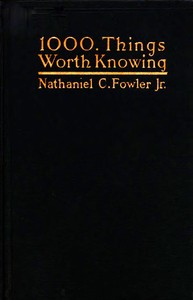
Before opening 1000 Things Worth Knowing — Reading Companion, the edition data offers a quick orientation: 47,443 words, 3 hr 27 min estimated reading time, and 11 detected text sections.
The text analysis averages about 13.8 words per sentence, while the detected sections provide another way to judge how the source is divided.
Project Gutenberg metadata also associates the work with “Encyclopedias and dictionaries,” connecting these edition facts with the source record’s subject description.
Explore this collection
These alternatives are selected using recorded categories and estimated reading time.
About 215 minutes
Adventure Picaresque Fiction
49,290 recorded words. 8 minutes difference from this book's estimate.
View Gutenberg source #16732About 180 minutes
Adventure Picaresque Fiction
41,235 recorded words. 27 minutes difference from this book's estimate.
View Gutenberg source #25942About 246 minutes
Adventure Picaresque Fiction
56,449 recorded words. 39 minutes difference from this book's estimate.
View Gutenberg source #31016Search stored excerpts and compare books → Choose by your preferences →
Choices use stored catalog measurements. Estimates vary with reading speed. A shared category is a catalog label, not a claim that two books have the same argument or literary quality.
Search reads excerpt text stored with this catalog and links to its associated Gutenberg record. The connection is stored in the site database; this tool does not recheck that every excerpt is word-for-word identical to that external record. Excerpt search does not cover every chapter and does not verify historical publication dates.
Catalog snapshot checked: 2026-09-25. Coverage: 92 public books, 92 available source excerpts.
Read the complete public-domain text at its original source.
Read on Project GutenbergNathaniel C. Fowler Jr.’s 1000 Things Worth Knowing (1913) is a compact reference work that promises more than a thousand facts “of interest to humankind,” written in “the simplest English” to avoid technical jargon. The preface explicitly states the book is not for scientists, positioning itself as a practical guide for the average person. The excerpts reveal a striking range: from a list of abbreviations (A.B. to LL.D.) to sporting records for airships, automobiles, baseball, billiards, and endurance feats, alongside song lyrics and advice on eyeglasses. This miscellany reflects Fowler’s ambition to cover “things which are really worth knowing” without the “unprofitable length” of specialized texts.
The opening excerpt presents a list of abbreviations “in common use,” focusing heavily on academic degrees: A.B., A.M., B.D., LL.D., and many others. The list includes both familiar terms (C.O.D., F.O.B.) and obscure ones like E.D. (Doctor of Electricity) and B.Pd. (Bachelor of Pedagogy). This section suggests that Fowler assumed his readers would encounter such titles in formal contexts and needed a quick reference. The inclusion of degrees from agriculture to veterinary surgery indicates a broad view of professional education in the early 20th century. Notably, the list omits many common abbreviations we might expect today, such as those for states or months, hinting at the era’s specific informational priorities.
A substantial portion of the excerpts is devoted to sporting and endurance records, compiled from “the latest and best authorities.” These include airship altitude (17,881 feet), automobile mile times (25.40 seconds), and baseball history from 1845 to 1911. The endurance records are particularly detailed: a relay race from New York to Chicago (118 hours, 35 minutes), a 1,000-mile walk in 1,000 consecutive hours, and a walk from the Atlantic to the Pacific Ocean in 1910. The precision of these entries—down to fractions of seconds and yards—reflects a fascination with measurable human achievement. The baseball section notes the first salaried team in 1868 and the largest attendance (38,281 in 1911), offering a snapshot of the sport’s professionalization.
Interspersed among the facts are snippets of song lyrics, such as “Maryland, My Maryland” and “When Johnny Comes Marching Home,” credited to Harper’s “Book of Facts.” These appear without context, suggesting they are included as cultural reference points. A brief paragraph on spectacles advises readers not to fit glasses themselves but to consult an optician or oculist. This practical tip, placed among records and abbreviations, exemplifies Fowler’s mix of the useful and the curious. The song lyrics, while fragmentary, hint at a patriotic or sentimental vein, though the excerpts do not reveal how many songs are included or their arrangement.
Fowler’s book is best approached as a period curiosity: a snapshot of what an early 20th-century editor deemed “worth knowing.” Readers should use the index, as the preface recommends, to navigate its eclectic contents. The work rewards browsing but resists linear reading; its value lies in the specific, dated details—like a 1911 baseball attendance figure or a 1910 transcontinental walk—that illuminate the era’s interests and standards of knowledge.
I think of 1000 Things Worth Knowing on its shelf, a 1913 voice trusting plain facts to steady anyone's day. Beside it rests a dear cousin, The Handy Cyclopedia of Things Worth Knowing A Manual of Ready Reference — Text and Context, sharing that same patient breath. They whisper across decades, both seeking order in a noisy world—old friends who never tired of being useful.
Build a private reading journal entry for this title.









