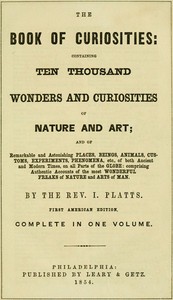
The Book of Curiosities opens with a table of contents that reads like a cabinet of wonders: 'Abstinence, wonders of' sits next to 'Act of faith,' and 'Alarm bird' precedes 'Alexandria, buildings and library of.' The Rev. I. Platts, writing in 1854, does not merely list facts; he weaves them into a narrative that shifts between awe and explanation. The entry on the sea, for instance, begins with a precise calculation—'5,280,000,000 tons of water'—then moves through a list of five mechanisms for water ascent, and finally dissolves into a dramatic description of storms and whirlpools. This alternation between quantitative detail and rhetorical flourish is the book's signature.
Numbers and Wonder
The sea entry shows how Platts uses numbers to ground his marvels. He states that the sea receives '1,827,000,000 tons per day' from its nine great rivers, yet loses more to evaporation. Such figures are not mere decoration; they serve as evidence for a natural system. He then cites Dr. Plot's five explanations for how water rises above its level—subterranean heat, filtration, unequal sea heights, the earth's center of gravity, and storms. The list is methodical, almost scientific, but the tone remains that of a collector displaying curiosities. The numbers create a sense of scale, making the subsequent description of tempests more vivid.
The Rhetoric of Terror
When Platts turns to the sea's dangers, his prose becomes elaborate and rhythmic. He describes ships 'breaking from their anchor, or driven from their course,' and 'whirlpools, or vast masses of water with a violently circular motion.' The sentences lengthen, piling up clauses to mimic the accumulating force of a storm. He uses the word 'terrific' not as hyperbole but as a precise term for the sublime. This shift from plain exposition to heightened language is a deliberate change in pace, marking moments of maximum wonder. The reader is meant to feel the 'roar of the waves' before being returned to calmer explanation.
Moral Purpose in Natural History
Platts interrupts his description of sea salt to assert that 'it would be highly unjust and ungrateful, only to consider the losses occasioned by the sea, without reflecting upon the magnificent and stupendous works of God.' This moral framing is typical: the book's wonders are never neutral. The saltiness of the sea, he notes, 'is absolutely necessary to accomplish certain ends'—preservation and buoyancy. Even the color of water is tied to divine design. By alternating between physical explanation and theological reflection, Platts creates a rhythm that elevates his encyclopedia from a list of facts to a devotional work. The reader is invited to marvel, but also to give thanks.
Readers approaching The Book of Curiosities should attend to its shifts in register. Platts moves from dry enumeration to dramatic narrative to moral lesson within a single entry. The table of contents is a map of these transitions: 'Air, its pressure and elasticity' leads to 'Alarm bird,' and 'Anagrams' to 'Androides.' The book rewards those who read not for information alone, but for the pleasure of watching a Victorian mind organize the world into a series of astonishments.
I kept thinking about how that old encyclopedia squeezed whole oceans into a paragraph, mixing facts with quiet awe. It reminded me of Of the Decorative Illustration of Books Old and New 3rd ed. — Story, Setting & Ideas—both feel like someone took time to notice the small, strange details we usually rush past. That lingering sense stays with me after closing either one.