About 168 minutes
English Translations from the Greek: A Bibliographical Survey — Reading Companion
Fantasy Juvenile Worlds
38,516 recorded words. 13 minutes difference from this book's estimate.
View Gutenberg source #48950
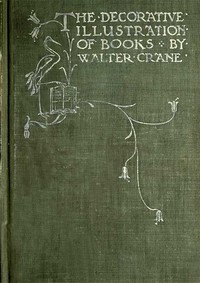
The source record for Of the Decorative Illustration of Books Old and New 3rd ed. — Story, Setting & Ideas measures this digital text at 35,456 words, 2 hr 35 min estimated reading time, and 10 detected text sections.
The text analysis averages about 18.6 words per sentence, while the detected sections provide another way to judge how the source is divided.
Project Gutenberg metadata also associates the work with “Illumination of books and manuscripts,” connecting these edition facts with the source record’s subject description.
Explore this collection
These alternatives are selected using recorded categories and estimated reading time.
About 168 minutes
Fantasy Juvenile Worlds
38,516 recorded words. 13 minutes difference from this book's estimate.
View Gutenberg source #48950About 116 minutes
Fantasy Juvenile Worlds
26,661 recorded words. 39 minutes difference from this book's estimate.
View Gutenberg source #70398About 115 minutes
Fantasy Juvenile Worlds
26,236 recorded words. 40 minutes difference from this book's estimate.
View Gutenberg source #4001Search stored excerpts and compare books → Choose by your preferences →
Choices use stored catalog measurements. Estimates vary with reading speed. A shared category is a catalog label, not a claim that two books have the same argument or literary quality.
Search reads excerpt text stored with this catalog and links to its associated Gutenberg record. The connection is stored in the site database; this tool does not recheck that every excerpt is word-for-word identical to that external record. Excerpt search does not cover every chapter and does not verify historical publication dates.
Catalog snapshot checked: 2026-09-25. Coverage: 92 public books, 92 available source excerpts.
Read the complete public-domain text at its original source.
Read on Project GutenbergWalter Crane opens his third edition by framing the book as an extension of three Cantor Lectures delivered in 1889, amplified with new chapters on recent printing and illustration. He immediately establishes a central distinction: his concern is with illustrations that function as book ornaments, not merely as graphic statements. This structural principle governs the entire work, as Crane consistently evaluates images by their relationship to type, margins, and the physical page.
The book is organized as a historical survey moving from medieval manuscripts to contemporary presses, but Crane repeatedly interrupts chronology to dwell on specific technical conditions—wood engraving, colour printing, the Japanese influence that he credits with inspiring his own bold outlines and flat tints. His voice is that of a practitioner explaining craft from the inside, not a detached critic.
Crane’s core argument is that book illustration must be conceived as part of a unified page, not as an independent picture inserted into a text block. He draws a firm line between “the art of pictorial statement” and “the art of decorative treatment,” insisting that the most complete book-pictures combine both. This is not an abstract ideal; Crane demonstrates it by pointing to specific examples where designers respected the “conditions of the book page and the press.”
He praises Henry Holiday’s illustrations to Lewis Carroll’s Hunting of the Snark as “admirable” precisely because Holiday’s decorative feeling in black and white is “marked.” Similarly, he commends Randolph Caldecott’s headpiece to Bracebridge Hall as a good example of Caldecott’s style “when his aim was chiefly decorative.” The recurring criterion is whether the image acknowledges its architectural role within the book’s layout.
Crane devotes notable attention to children’s books, which he calls “the only outlet for unrestricted flights of fancy open to the modern illustrator.” He recounts his own early work with the colour printer Edmund Evans, contrasting the “careless and unimaginative woodcuts” of cheap toy books from the 1860s with the more deliberate designs that followed. The turning point, he claims, came from Japanese printed pictures given to him by a naval lieutenant—an influence that led him to adopt “strong outlines, flat tints, and solid blacks.”
He situates his own work alongside that of Randolph Caldecott and Kate Greenaway, though he notes that their aims are “more in the direction of character study” and “more of a pictorial character than strictly decorative.” Crane’s taxonomy here is revealing: he values decorative unity over narrative expression, and he uses his own career as a case study in how craft constraints can spur innovation.
Crane acknowledges that his book is “not nearly so complete or comprehensive as I could have wished,” citing the natural limits of the Ex-Libris series. He selects illustrations to represent “the chief historical and contemporary types of decorative book-illustration,” but he is candid about the gaps. For instance, he mentions that he could not obtain examples from H. S. Marks, whose coloured designs to nursery rhymes he remembers as an early attempt at decoration.
The historical chapters move from illuminated manuscripts to modern presses, but Crane’s focus remains on the ornamental aim. He repeatedly returns to the idea that the best book-pictures are those that respect the page’s architecture—a principle he traces through different periods and techniques. The survey is thus less a comprehensive history than a curated argument for a particular design philosophy.
Throughout the book, Crane emphasizes the collaborative nature of book production. He thanks Gleeson White for “most valuable help” and acknowledges the printers and publishers who supplied examples. His own experience with Edmund Evans taught him “the possibilities” of colour printing, and he credits that partnership with shaping his approach to children’s books.
Crane’s prose is that of a working designer: he speaks of “intervals snatched from the absorbing work of designing,” and he evaluates illustrations by how well they function within the physical constraints of the page. This practical perspective gives the book a distinctive voice—less a scholarly treatise than a master craftsman’s reflection on his trade. The third edition’s revisions, including new chapters on recent developments, show Crane trying to keep pace with a rapidly changing field.
Crane’s book is best approached as a designer’s manifesto disguised as a history. Readers interested in the technical evolution of book illustration will find detailed observations on wood engraving, colour printing, and page layout; those seeking a broader cultural history may need to supplement it with other sources. The value of this edition lies in Crane’s insistence on the decorative integrity of the book page—a principle that remains relevant for anyone concerned with the relationship between image and text.
Crane wanted books to feel whole, every page a deliberate part of the story. There’s something tender in that old care for structure—it reminds me of thumbing through a vast dictionary, not hunting for a fact, just feeling the weight of all those patient entries. I found that same quiet respect in the Encyclopaedia Britannica, 11th Edition, "Armour Plates" to "Arundel, Earls of" Volume 2, Slice 6 — Edition Insights, where even the fragments feel like they belonged to someone’s careful afternoon.
Save your reaction, strongest insight, and memorable passage.









