About 43 minutes
Catalogue of Practical and Scientific Books — A Reader’s Guide
Science Fiction Utopias
9,690 recorded words. 0 minutes difference from this book's estimate.
View Gutenberg source #54752
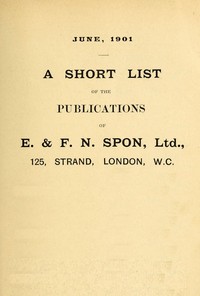
This digital edition of A Short List of the Publications of E. & F. N. Spon, Ltd. June 1901 — Story, Setting & Ideas is described by source-level measurements including 9,752 words, 43 min estimated reading time, and 11 detected text sections.
The text analysis averages about 9.7 words per sentence, while the detected sections provide another way to judge how the source is divided.
Project Gutenberg metadata also associates the work with “Publishers' catalogs -- England -- London,” connecting these edition facts with the source record’s subject description.
Explore this collection
These alternatives are selected using recorded categories and estimated reading time.
About 43 minutes
Science Fiction Utopias
9,690 recorded words. 0 minutes difference from this book's estimate.
View Gutenberg source #54752About 36 minutes
Science Fiction Utopias
8,171 recorded words. 7 minutes difference from this book's estimate.
View Gutenberg source #13714About 34 minutes
Science Fiction Utopias
7,763 recorded words. 9 minutes difference from this book's estimate.
View Gutenberg source #3617Search stored excerpts and compare books → Choose by your preferences →
Choices use stored catalog measurements. Estimates vary with reading speed. A shared category is a catalog label, not a claim that two books have the same argument or literary quality.
Search reads excerpt text stored with this catalog and links to its associated Gutenberg record. The connection is stored in the site database; this tool does not recheck that every excerpt is word-for-word identical to that external record. Excerpt search does not cover every chapter and does not verify historical publication dates.
Catalog snapshot checked: 2026-09-25. Coverage: 92 public books, 92 available source excerpts.
Read the complete public-domain text at its original source.
Read on Project GutenbergThe catalog opens with a stark title page and a list of agricultural works, but quickly pivots to architecture and building, where entries like “The Builder’s Clerk. Second edition. fcap. 8vo 1 6” set a pattern of compressed information. Each entry typically includes author, title, edition, format, and price, with no descriptive blurbs. This telegraphic style forces the reader to infer the book’s content from its title alone, creating a rhythm of rapid scanning.
As the catalog progresses, the headings shift from broad domains like “Agriculture” to specialized subfields such as “Sanitation” and “Warming and Ventilation.” The uniformity of the listings—each a single line of text—mirrors the efficiency prized by the intended audience of engineers and builders.
The catalog begins with agriculture—cotton, coffee, sugar, hops—but these early entries are soon overshadowed by the sheer volume of engineering and building titles. Under “Architecture and Building,” works like Chimney Design and Theory and Specifications in Detail appear alongside practical manuals such as The Clerk of Works’ Vade Mecum. The listing for Roman Architecture, Sculpture and Ornament at five guineas stands out as a luxury item among the shilling handbooks.
Later sections on railways, sanitation, and water supply reinforce the catalog’s focus on infrastructure. The inclusion of Las Obras de Salubridad de la Ciudad de Buenos Aires hints at an international reach. The catalog’s structure itself tells a story: the reader moves from the soil to the city, from cultivation to construction.
Every entry follows a rigid formula: author, title, edition, format, and price. Punctuation is minimal—commas and periods separate elements, but no full sentences appear. This economy of language mirrors the technical handbooks being advertised, where clarity trumps flourish. For example, “Burns, G. J. Glossary of Technical Terms used in Architecture and the Building Trades. Crown 8vo 3 6” conveys all necessary information in a single line.
The catalog rarely uses adjectives beyond “practical” or “complete.” When it does, as in “A Complete and Practical Treatise on Plumbing & Sanitation,” the emphasis is on utility. The repetition of phrases like “New edition” or “In the Press” signals a living, updating body of knowledge. The reader is expected to recognize the value of a fifteenth edition of A Handbook of Formulæ, Tables and Memoranda without further explanation.
The catalog’s pace is determined by its layout: dense blocks of text under subject headings, with occasional white space marking transitions. Early sections like “Agriculture” are brief, while “Architecture and Building” runs for pages, creating a sense of acceleration. The shift to “Useful Tables” introduces a new rhythm, with entries like “Barlow’s Tables of Squares, Cubes, Square Roots, Cube Roots & Reciprocals” offering a different kind of reading—one of reference rather than recommendation.
The final pages, dominated by the Project Gutenberg license, abruptly change tone and pace. The legal language contrasts sharply with the terse listings, reminding the reader that this digital edition is a reproduction. The catalog itself, however, maintains a steady, unvarying tempo throughout its commercial listings, each entry a small, self-contained unit.
This catalog rewards a slow, attentive reading. Notice how the same author—T. E. Coleman—appears in both “Architecture and Building” and “Sanitation,” suggesting cross-disciplinary expertise. The prices, too, tell a story: most books cost between one and fifteen shillings, with a few expensive folios. As you browse, consider what these lists reveal about the knowledge economy of 1901—what was worth knowing, and what it cost to learn it.
That June catalog—terse titles, tables, the quiet confidence of engineering—reminded me how much a book can be a doorway. Rain kept me indoors, so I followed a footnote’s drift toward drama’s older definitions, stumbling into the Encyclopaedia Britannica, 11th Edition, "Drama" to "Dublin" Volume 8, Slice 7 — Inside the Classic. Both felt like old drawers, each listing something more than it said.
Your answers remain private and are stored only in this browser.









