About 114 minutes
Carnegie Library of Pittsburgh Debate Index Second Edition — Text and Context
Historical Psychological Social Fiction
25,992 recorded words. 16 minutes difference from this book's estimate.
View Gutenberg source #18347
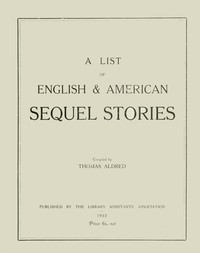
For A List of English & American Sequel Stories — Inside the Classic, the stored edition analysis reports 29,840 words, 2 hr 10 min estimated reading time, and 12 detected text sections.
The text analysis averages about 6.1 words per sentence, while the detected sections provide another way to judge how the source is divided.
Project Gutenberg metadata also associates the work with “American fiction -- Bibliography,” connecting these edition facts with the source record’s subject description.
Explore this collection
These alternatives are selected using recorded categories and estimated reading time.
About 114 minutes
Historical Psychological Social Fiction
25,992 recorded words. 16 minutes difference from this book's estimate.
View Gutenberg source #18347About 106 minutes
Historical Psychological Social Fiction
24,180 recorded words. 24 minutes difference from this book's estimate.
View Gutenberg source #71072About 105 minutes
Historical Psychological Social Fiction
24,058 recorded words. 25 minutes difference from this book's estimate.
View Gutenberg source #56678Search stored excerpts and compare books → Choose by your preferences →
Choices use stored catalog measurements. Estimates vary with reading speed. A shared category is a catalog label, not a claim that two books have the same argument or literary quality.
Search reads excerpt text stored with this catalog and links to its associated Gutenberg record. The connection is stored in the site database; this tool does not recheck that every excerpt is word-for-word identical to that external record. Excerpt search does not cover every chapter and does not verify historical publication dates.
Catalog snapshot checked: 2026-09-25. Coverage: 92 public books, 92 available source excerpts.
Read the complete public-domain text at its original source.
Read on Project GutenbergThomas Aldred’s 1922 compilation, A List of English & American Sequel Stories, originated as a staff reference list published in The Library World (1900–1901). The present edition expands that earlier work, adding numerous entries drawn from sources the compiler acknowledges as “of doubtful reliability.” Aldred’s preface is candid about probable errors of commission and omission, inviting corrections from readers. The list is organized alphabetically by author (or pseudonym), with series entries numbered sequentially. The volume was published by the Library Assistants’ Association, with profits directed to its Benevolent and Orphan Fund.
The list includes four categories: stories in which the same character appears across multiple books; series forming a continuous narrative; trilogies and similar groupings; and a few additional notes. Aldred omits publication dates and publishers to keep printing costs down, noting that such details are “easily obtainable from the usual reference works.” Compound surnames are entered under the latter part of the name, and pseudonyms are used without cross-references to real names. The entries range from well-known series—such as Kipling’s The Jungle Book and The Second Jungle Book—to obscure sequences like the “Commuter’s series” or “Diary series.”
Several entries illustrate the variety of sequel types. For example, Sir H. Johnston’s “Little Colonel story hour books” spans twelve volumes, while Kay’s “Big War series” includes nine titles from The Search for the Spy to The Underground Spy. Some sequels are explicitly linked to canonical works: The Gay-Dombeys is noted as a sequel to Dickens’ Dombey and Son, and Mrs. Warren’s Daughter to Shaw’s Mrs. Warren’s Profession. Aldred also includes a note that Kipling’s character Mulvaney appears in “a number of stories in several of Kipling’s books,” acknowledging a looser form of series connection.
Aldred’s preface reveals a practical, self-aware compiler. He describes the list as serving “useful purposes” and acknowledges the difficulty of obtaining reliable information about sequence-stories. The errata page further underscores the work’s provisional nature: it notes that E. Everett-Green’s Cheveley stories are entered both under “Anonymous stories” and under the author’s name—a clerical error. The list is a snapshot of early twentieth-century librarianship, shaped by constraints of budget and access, and its value lies in its documentary record of popular reading patterns rather than in bibliographic perfection.
Readers interested in the history of series fiction or in tracing the development of the sequel as a literary form will find this list a useful primary source. Aldred’s candid acknowledgment of gaps and errors invites users to treat the work as a starting point rather than a definitive bibliography. The volume also offers a glimpse into the reading tastes of the early 1900s, from juvenile series like the “Go-ahead boys” to literary continuations of classic novels.
Leafing through Aldred’s catalogue of sequel stories, I felt the gentle arithmetic of a bookshelf—each title waiting for its turn. It reminded me of another old list, one from 1886, full of promised adventures for young readers. That Blackie & Son's Books for Young People, Catalogue - 1886 — A Reader’s Guide holds a similar quiet optimism, a snapshot of stories yet to be unfolded.
Save your reaction, strongest insight, and memorable passage.









