About 105 minutes
Turgenev in English: A Checklist of Works by and about Him — Key Ideas to Explore
Historical Psychological Social Fiction
24,058 recorded words. 1 minutes difference from this book's estimate.
View Gutenberg source #56678
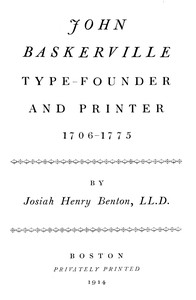
John Baskerville, type-founder and printer, 1706-1775 — Text and Context can be approached with a clearer sense of reading commitment from its source measurements: 24,180 words, 1 hr 46 min estimated reading time, and 7 detected text sections.
The text analysis averages about 20.3 words per sentence, while the detected sections provide another way to judge how the source is divided.
Project Gutenberg metadata also associates the work with “Printers -- Great Britain -- Biography,” connecting these edition facts with the source record’s subject description.
Explore this collection
These alternatives are selected using recorded categories and estimated reading time.
About 105 minutes
Historical Psychological Social Fiction
24,058 recorded words. 1 minutes difference from this book's estimate.
View Gutenberg source #56678About 114 minutes
Historical Psychological Social Fiction
25,992 recorded words. 8 minutes difference from this book's estimate.
View Gutenberg source #18347About 96 minutes
Historical Psychological Social Fiction
22,011 recorded words. 10 minutes difference from this book's estimate.
View Gutenberg source #35191Search stored excerpts and compare books → Choose by your preferences →
Choices use stored catalog measurements. Estimates vary with reading speed. A shared category is a catalog label, not a claim that two books have the same argument or literary quality.
Search reads excerpt text stored with this catalog and links to its associated Gutenberg record. The connection is stored in the site database; this tool does not recheck that every excerpt is word-for-word identical to that external record. Excerpt search does not cover every chapter and does not verify historical publication dates.
Catalog snapshot checked: 2026-09-25. Coverage: 92 public books, 92 available source excerpts.
Read the complete public-domain text at its original source.
Read on Project GutenbergBenton opens his biography of John Baskerville not with the man himself, but with a sweeping panorama of mid-18th-century England: the defeat of Jacobites at Culloden, the rise of the middle classes, the evangelical preaching of Whitefield and Wesley, and the imperial victories of Clive and Pitt. This contextual overture, covering nearly a page before Baskerville appears, establishes a deliberate narrative strategy—the author situates his subject within a dynamic historical moment before narrowing focus. The prose is brisk and declarative, favoring lists of events and figures over analytical depth, which gives the opening a lecture-like quality. Once Baskerville is introduced, the voice shifts: Benton becomes more specific, drawing on letters, contemporary reviews, and bibliographic details to trace the printer's career.
The most striking shift in narrative pace occurs between the first chapter and the subsequent ones. After the broad historical setup, Benton slows down to examine Baskerville's early life and the conditions of Birmingham, a town he describes as “emphatically the town of free trade.” The language becomes granular: we learn of Baskerville's first occupation as a servant at seventeen, his later work as a writing-master, and his experiments with japanning. Benton's sentences grow longer, packed with details about typefounding and printing processes. This change mirrors the book's structure—once the stage is set, the biography proceeds chronologically, but with frequent pauses for bibliographic description. For instance, the account of the 1762 Horace includes a full paragraph on the dispute over engraved plates, quoting Shenstone's complaint that he could have “rendered it better.” Such passages reveal Benton's interest in the collaborative and sometimes contentious nature of book production.
Benton relies heavily on quoted material from Baskerville's contemporaries, creating a polyphonic texture. Shenstone's letters, Dibdin's bibliomaniacal praise, and Dr. Harwood's scholarly judgments are woven into the text, each with its own tone. Shenstone is fussy and self-regarding; Dibdin effusive (“I never see, or even think of, the lovely edition of Baskerville, of 1773, 8vo, 4 vols., without the most unmixed satisfaction”); Harwood precise and evaluative. Benton rarely interrupts these voices with his own commentary, letting them speak directly. This technique gives the biography an archival feel, as if the reader is encountering primary sources firsthand. However, it also means the narrative pace can stall: a single paragraph may contain multiple quotations, each requiring the reader to adjust to a different speaker. The effect is cumulative rather than fluid, building a mosaic of contemporary opinion rather than a single authorial argument.
Benton's prose accelerates when he catalogs Baskerville's editions. The description of the 1773 Ariosto, for example, moves rapidly through subscriber numbers (491, with breakdowns by city), mentions of plates by Bartolozzi, and Dibdin's verdict that the edition “has hardly its equal.” The sentences become compressed, almost list-like: “There were 491 subscribers to this book, of whom 230 were in London, 121 in Paris, 8 in Madrid, 14 in Holland, Russia, and Germany, and 118 in Italy.” This rhythm contrasts with the more leisurely passages on Baskerville's personal life. The effect is a book that oscillates between two modes: the biographical narrative, which proceeds at a moderate pace, and the bibliographical survey, which rushes through details. Readers interested in the physical book as artifact may find the latter sections rewarding, while those seeking a continuous life story may note the frequent interruptions for descriptive cataloging.
Benton's biography rewards a reading that attends to its shifts in tempo and its use of quoted voices. The book is as much a collection of evidence about Baskerville's reputation among his peers as it is a chronological account of his life. For a full appreciation, consider reading the historical introduction quickly, then slowing down for the detailed accounts of individual editions, where the most vivid contemporary reactions appear.
Reading about Baskerville’s patient method, how each typeface demanded its own quiet obsession, I recalled my own hours with John Baskerville, type-founder and printer under lamplight. It felt like tracing old maps—the same unhurried reverence I found later in A Selected Bibliography of Virginia, 1607-1699 — Key Ideas to Explore, as if both books were whispering that small, careful records outlast grand declarations.
Your answers remain private and are stored only in this browser.









