About 162 minutes
The Library of William Congreve — Background and Themes
Science Fiction Utopias
37,229 recorded words. 29 minutes difference from this book's estimate.
View Gutenberg source #27606
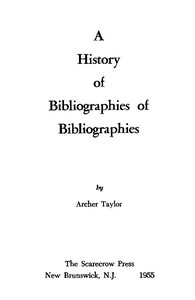
A History of Bibliographies of Bibliographies — Background and Themes can be approached with a clearer sense of reading commitment from its source measurements: 43,758 words, 3 hr 11 min estimated reading time, and 6 detected text sections.
The text analysis averages about 16.4 words per sentence, while the detected sections provide another way to judge how the source is divided.
Project Gutenberg metadata also associates the work with “Bibliography of bibliographies -- History,” connecting these edition facts with the source record’s subject description.
Explore this collection
These alternatives are selected using recorded categories and estimated reading time.
About 162 minutes
Science Fiction Utopias
37,229 recorded words. 29 minutes difference from this book's estimate.
View Gutenberg source #27606About 139 minutes
Science Fiction Utopias
31,811 recorded words. 52 minutes difference from this book's estimate.
View Gutenberg source #52841About 279 minutes
Science Fiction Utopias
64,153 recorded words. 88 minutes difference from this book's estimate.
View Gutenberg source #17857Search stored excerpts and compare books → Choose by your preferences →
Choices use stored catalog measurements. Estimates vary with reading speed. A shared category is a catalog label, not a claim that two books have the same argument or literary quality.
Search reads excerpt text stored with this catalog and links to its associated Gutenberg record. The connection is stored in the site database; this tool does not recheck that every excerpt is word-for-word identical to that external record. Excerpt search does not cover every chapter and does not verify historical publication dates.
Catalog snapshot checked: 2026-09-25. Coverage: 92 public books, 92 available source excerpts.
Read the complete public-domain text at its original source.
Read on Project GutenbergArcher Taylor opens his study with a precise definition: he uses 'bibliography of bibliographies' only for works of universal scope, explicitly excluding national bibliographies, special lists, and library catalogues. This narrow focus sets the stage for a rigorous examination of how scholars have attempted to catalog all bibliographies. Taylor immediately establishes his critical method by evaluating predecessors like Vallée, Petzholdt, and Stein, pointing out flaws in arrangement, indexing, and completeness. The preface also reveals Taylor's reliance on rare books and his willingness to correct errors in quoted titles when pertinent. Readers should note that Taylor's judgments are based on direct examination of the works he discusses, and he often cites specific page numbers or entry numbers to support his claims.
Taylor's preface is essential for understanding his criteria. He excludes national bibliographies, such as Ottino and Fumagalli's Bibliotheca bibliographica italiana, and special lists like Peignot's Répertoire des bibliographies spéciales. He also rules out chapters on the bibliography of bibliographies in library handbooks, classified library catalogues, and private library catalogues. Only subject indexes published before the bibliography of bibliographies was recognized as an independent scholarly undertaking are included, such as Conrad Gesner's Pandectae (1548) and Israel Spach's Nomenclator (1598). This deliberate narrowing allows Taylor to focus on the core tradition of universal bibliographies, but it also means that many related works are mentioned only in passing. Readers should be aware that Taylor's definitions shape the entire narrative, and his exclusions are as important as his inclusions.
In the first chapter, Taylor dissects the work of Léon Vallée, a compiler of a bibliography of bibliographies published in the 1880s. Taylor notes that Vallée recognized only three predecessors: Tonnelli (1782), Petzholdt (1866), and Sabin (1872, with a wrong date). Taylor dismisses Tonnelli's book as a 'worthless mixture' and a 'rubbish heap,' and criticizes Vallée for not fully accepting Petzholdt's work as a model. He points out that Vallée misdates Sabin's book, which began serial publication in 1875. Taylor then examines Vallée's classification, finding that he placed Peignot's Répertoire and Labbé's works in a section titled 'Bibliographies générales' rather than recognizing them as bibliographies of bibliographies. Taylor concludes that Vallée 'did not recognize a bibliography of bibliographies when he saw it.' This detailed critique exemplifies Taylor's method: he uses specific examples to assess the accuracy and judgment of earlier bibliographers.
Taylor repeatedly emphasizes the importance of arrangement and indexing in bibliographies of bibliographies. He criticizes Petzholdt and Stein for choosing a classified arrangement with 'altogether unsatisfactory subject indexes and hastily-made author indexes.' He also mentions Josephson, who arranged titles in chronological order without any author or subject index—an arrangement Taylor says 'no one has ever recommended.' Taylor himself prefers a subject arrangement with an author index, though he acknowledges that he 'stand[s] alone against general bibliographical practice.' This focus on practical usability reveals Taylor's concern for the working scholar. He also notes that Vallée's supplement of 1887 failed to repair faults that reviewers had pointed out, suggesting that Taylor values responsiveness to criticism. Readers should pay attention to how Taylor evaluates the structural choices of each bibliography he discusses.
Taylor lists numerous faults in Vallée's work: including titles that do not belong, incomplete and inaccurate descriptions, citing easily found bibliographies, failing to analyze long subject entries, and making serious errors in names, dates, titles, and places of publication. He also criticizes Vallée's 'rash attempt to survey all bibliographies anew with little or no regard for his predecessors.' However, Taylor offers a qualified defense: Vallée was the first compiler to base his work on the books in a particular library (the Bibliothèque Nationale), and his faults are partly mitigated by the difficulty of the task. Taylor also notes that Vallée's inclusion of fringe materials is not as extensive as it might seem. This balanced assessment shows Taylor's willingness to acknowledge merit even in flawed works. The passage illustrates Taylor's scholarly ethos: rigorous criticism tempered by an understanding of the practical challenges faced by early bibliographers.
Taylor's history is not a simple chronicle but a critical dialogue with his predecessors. Readers will benefit from noting the specific criteria he applies—scope, arrangement, indexing, accuracy, and originality. The excerpts show that Taylor values careful definition and methodological consistency. As you read, consider how Taylor's own work fits into the tradition he describes: does he avoid the faults he condemns? His preface and first chapter provide a framework for evaluating the later chapters on periodical and cooperative enterprises.
There’s something comforting in how Taylor lingers over old compilers’ choices, wondering why they kept some works and dropped others. It reminds me of leafing through Fine Books — A Closer Reading, where the physical object itself becomes a kind of quiet biography. So much of our love for books is really love for the people who made room for them.
Save your reaction, strongest insight, and memorable passage.









