About 971 minutes
The reader's guide to the Encyclopaedia Britannica — Background and Themes
Historical Psychological Social Fiction
223,217 recorded words. 2521 minutes difference from this book's estimate.
View Gutenberg source #74039
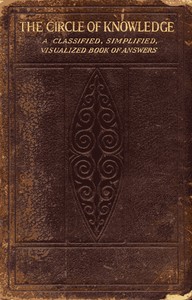
For The Circle of Knowledge: A Classified, Simplified, Visualized Book of Answers — Text and Context, the stored edition analysis reports 803,000 words, 58 hr 12 min estimated reading time, and 126 detected text sections.
The text analysis averages about 14.2 words per sentence, while the detected sections provide another way to judge how the source is divided.
Project Gutenberg metadata also associates the work with “Encyclopedias and dictionaries,” connecting these edition facts with the source record’s subject description.
Explore this collection
These alternatives are selected using recorded categories and estimated reading time.
About 971 minutes
Historical Psychological Social Fiction
223,217 recorded words. 2521 minutes difference from this book's estimate.
View Gutenberg source #74039About 709 minutes
Historical Psychological Social Fiction
162,978 recorded words. 2783 minutes difference from this book's estimate.
View Gutenberg source #55727About 330 minutes
Historical Psychological Social Fiction
75,764 recorded words. 3162 minutes difference from this book's estimate.
View Gutenberg source #30073Search stored excerpts and compare books → Choose by your preferences →
Choices use stored catalog measurements. Estimates vary with reading speed. A shared category is a catalog label, not a claim that two books have the same argument or literary quality.
Search reads excerpt text stored with this catalog and links to its associated Gutenberg record. The connection is stored in the site database; this tool does not recheck that every excerpt is word-for-word identical to that external record. Excerpt search does not cover every chapter and does not verify historical publication dates.
Catalog snapshot checked: 2026-09-25. Coverage: 92 public books, 92 available source excerpts.
Read the complete public-domain text at its original source.
Read on Project GutenbergHenry W. Ruoff's The Circle of Knowledge (1917) announces its ambition in its subtitle: a classified, simplified, visualized book of answers. The work is organized into 126 text sections covering nature, geography, history, science, and more, each designed to separate essentials from non-essentials. The editor's prefatory note classifies books into four types—information, inspiration, entertainment, excitement—and places this volume firmly in the first, while aiming also to inspire and entertain. The structure reflects a progressive, modern spirit, with numerous illustrations, maps, tables, and color plates.
The encyclopedia is divided into broad categories such as Nature, Geography, History, Government, Science, Invention, Education, Language, Literature, Fine Arts, Philosophy, Religion, Industry, Biography, Human Culture, and Universal Progress. Each section presents facts in a simplified, easy-to-read format. For instance, the entry on Turkey covers mineral products, agriculture, commerce, people, religion, education, and government in a logical sequence, moving from physical resources to human institutions. This classification allows readers to locate information quickly, but also imposes a fixed order that may obscure connections between topics.
The title's Circle of Knowledge suggests a cyclical, encompassing structure, yet the text proceeds linearly through sections. The editor emphasizes visualization: the work is designed to be 'easy to read; easy to understand; easy to retain.' The use of illustrations, maps, and color plates reinforces this visual approach. In the Turkey entry, for example, the description of 'green, black, and white marble' and 'the finest quality of granite' evokes a vivid picture of the landscape. The recurring mention of 'living facts' and 'human interest subjects' indicates a deliberate effort to make abstract knowledge concrete and memorable.
The text frequently shifts from broad overviews to specific details, creating a dynamic reading experience. In the Turkey section, the narrative moves from the general mineral wealth of Asiatic Turkey to particular locations like Angora, Sivas, and Trebizond. It then zooms in on agricultural products—oats, barley, wheat, grapes, oranges—and even notes the cultivation of mulberry for silkworms. This movement between macro and micro scales mirrors the encyclopedia's goal of providing both essentials and sidelights. The transitions are abrupt but functional, reflecting the work's design as a reference tool rather than a continuous narrative.
Although the encyclopedia aims for timeless facts, it is firmly rooted in its 1917 publication date. The Turkey entry discusses the 1908 Young Turk revolution and the subsequent establishment of parliamentary government, noting that 'government by a national assembly has taken root in Turkey.' It also mentions the annexation of Bosnia and Herzegovina by Austria-Hungary and Bulgaria's independence. These references provide a snapshot of geopolitical realities just before World War I. Similarly, the editor's preface reflects early 20th-century educational philosophy, emphasizing self-questioning and individual progress. Readers should be aware that some information, such as population figures or political conditions, is historically specific.
Ruoff's encyclopedia is best approached as a period artifact that organizes knowledge through classification, visualization, and concise exposition. Its structure rewards browsing: one can start with a single entry and follow cross-references to related topics. The work's strength lies in its clarity and breadth, though its datedness invites critical reflection. For modern readers, it offers a window into how early 20th-century Americans understood the world—a circle of knowledge that was both comprehensive and constrained by its era.
That rainy afternoon, Ruoff’s encyclopedia kept pulling me sideways—from its tidy categories into the messy edges between them, where one entry shadowed another. I lingered on Whitman, his name appearing in a footnote, and somehow the book’s quiet insistence on context led me to The Bibliography of Walt Whitman — Key Ideas to Explore. The rain never stopped; neither did that thread.
Your answers remain private and are stored only in this browser.









