About 96 minutes
Some notes on the bibliography of the Philippines — Inside the Classic
Historical Psychological Social Fiction
22,011 recorded words. 1 minutes difference from this book's estimate.
View Gutenberg source #35191
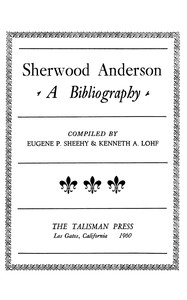
The source record for Sherwood Anderson — A Closer Reading measures this digital text at 21,689 words, 1 hr 35 min estimated reading time, and 11 detected text sections.
The text analysis averages about 7.7 words per sentence, while the detected sections provide another way to judge how the source is divided.
Project Gutenberg metadata also associates the work with “Anderson, Sherwood, 1876-1941 -- Bibliography,” connecting these edition facts with the source record’s subject description.
Explore this collection
These alternatives are selected using recorded categories and estimated reading time.
About 96 minutes
Historical Psychological Social Fiction
22,011 recorded words. 1 minutes difference from this book's estimate.
View Gutenberg source #35191About 93 minutes
Historical Psychological Social Fiction
21,338 recorded words. 2 minutes difference from this book's estimate.
View Gutenberg source #17719About 105 minutes
Historical Psychological Social Fiction
24,058 recorded words. 10 minutes difference from this book's estimate.
View Gutenberg source #56678Search stored excerpts and compare books → Choose by your preferences →
Choices use stored catalog measurements. Estimates vary with reading speed. A shared category is a catalog label, not a claim that two books have the same argument or literary quality.
Search reads excerpt text stored with this catalog and links to its associated Gutenberg record. The connection is stored in the site database; this tool does not recheck that every excerpt is word-for-word identical to that external record. Excerpt search does not cover every chapter and does not verify historical publication dates.
Catalog snapshot checked: 2026-09-25. Coverage: 92 public books, 92 available source excerpts.
Read the complete public-domain text at its original source.
Read on Project GutenbergThe preface to this bibliography immediately asserts that Sherwood Anderson's most significant contribution was as a writer of short stories, focusing on form rather than plot. It credits him with liberating the American short story from the genteel tradition, a claim supported by the inclusion of a manuscript page from Winesburg, Ohio (1919) and a photograph by Edward Steichen. The compilers, Eugene P. Sheehy and Kenneth A. Lohf, structure the work into two main parts: works by Anderson and writings about him, with detailed sections for individual works, periodical contributions, and reviews.
The preface, likely written by the compilers, states that Anderson's concentration on form over plot was key in liberating the short story from the genteel tradition. It identifies Winesburg, Ohio as his first important work, a collection about small-town inhabitants who do not fit community patterns. The compilers note Anderson's concern with failures rather than successes, told with compassion and sympathy. This critical framing shapes how a reader approaches the bibliography: as a tool for understanding Anderson's formal innovations and thematic focus on suppressed emotions.
The bibliography is divided into two main parts: works by Anderson and writings about him. The first part includes sections for individual works, essays and stories, introductions, letters, dramatizations, periodical contributions, serial publications, and Smyth County News contributions. The second part covers books, articles, poems, parodies, and reviews. An index is provided. This structure allows a reader to trace Anderson's output and critical reception systematically. The inclusion of a manuscript page from Winesburg, Ohio and the binding of Windy McPherson's Son as illustrations offers visual anchors for his early career.
For a first reading of Anderson, this bibliography offers a roadmap. The preface provides a concise critical lens, while the listings of individual works and periodical contributions show the breadth of his output. The section on writings about Anderson, including reviews and critical studies, allows a reader to explore contemporary and later interpretations. The inclusion of items like Louis J. Budd's "The grotesques of Anderson and Wolfe" (1959-60) suggests a critical tradition linking Anderson to other writers. A reader might start with the preface, then consult the entries for Winesburg, Ohio and key critical works to deepen understanding.
This bibliography is best used as a reference tool rather than a continuous read. The preface offers the most direct guidance for a first-time reader of Anderson, while the detailed listings support deeper research. The compilers' emphasis on Anderson's short stories and their formal innovation provides a focused entry point into his work.
There’s something about how Sheehy and Lohf trace Anderson’s quiet break from the old ways—his stories feeling like a door left slightly open. It reminded me of that old catalogue, Blackie & Son's Books for Young People, Catalogue - 1886 — A Reader’s Guide, where every title promised a gentle world. Both linger because they weren’t trying to be grand, just true.
Build a private reading journal entry for this title.









