
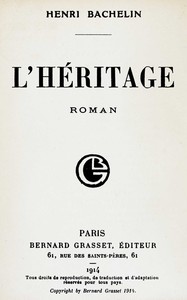
L'héritage : roman by Henri Bachelin
I picked up 'L'héritage' expecting a classic tale of fortune and fate. What I found was something much quieter, sharper, and more human. Henri Bachelin, writing in 1913, captures a moment in time with startling clarity, but the family drama at its heart feels like it could happen tomorrow.
The Story
The novel centers on the Laurent family, farmers living a hard but steady life in the French countryside. Their world is turned upside down when they inherit a plot of land from a cousin. It should be a blessing. Instead, it becomes a curse. The father sees security; the mother sees worry. One son dreams of selling it for a fresh start, while another feels a deep, almost spiritual tie to the soil. As they debate what to do—farm it, sell it, divide it—the inheritance stops being about the land itself. It becomes a mirror, reflecting every crack in their relationships. The story follows the slow, painful process of a family discovering that the most dangerous thing you can inherit isn't debt or treasure, but the chance to see each other's true colors.
Why You Should Read It
Don't come to this book for fast-paced action or sweeping romance. Come to it for its incredible quiet honesty. Bachelin has a gift for writing about inner life. You understand why a character hesitates to speak, or why a simple glance across the dinner table carries so much weight. The tension builds not through loud arguments, but through suppressed feelings and unspoken judgments. The real conflict isn't person vs. person, but person vs. their own changing heart. The setting is so vividly drawn—the smell of the earth, the weight of the seasons, the rhythm of farm work—that it becomes a character itself. It made me think about my own family and the things, both tangible and invisible, that we pass down to each other.
Final Verdict
This is a book for a specific, wonderful kind of reader. It's perfect for anyone who loves character studies and doesn't mind a story that simmers rather than boils. If you enjoyed the nuanced family dynamics in novels by authors like Thomas Hardy or George Eliot, but set in a distinctly French rural world, you'll feel right at home. It's also a fascinating read for anyone interested in early 20th-century life, capturing a way of living that was on the brink of disappearing. Just be prepared: by the end, you'll look at your own family dinners a little differently.
This text is dedicated to the public domain. Knowledge should be free and accessible.
Mark Gonzalez
8 months agoEnjoyed every page.
Michelle Johnson
1 year agoWow.
Robert Walker
10 months agoIf you enjoy this genre, it manages to explain difficult concepts in plain English. Don't hesitate to start reading.





Deborah Harris
1 year agoRead this on my tablet, looks great.