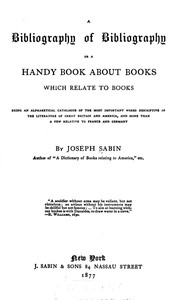
Joseph Sabin opens his 1877 Bibliography of Bibliography with a frank account of its origins: it grew out of John Power's Handy Book about Books, a work Sabin found disappointing because Power had not personally examined the books he described. Sabin set out to improve on that effort, producing a list about four times larger, though he admits it is not complete—such a work, he says, is beyond any one man's capacity. The preface also includes a pointed remark about librarians who display a 'plentiful lack of knowledge,' contrasting them with Charles A. Cutter of the Boston Athenæum, whom he praises for his 'standard of library intelligence.'
A Preface That Sets the Tone
Sabin's preface is notable for its direct, evaluative voice. He does not simply list sources; he judges them. Of Power's work he writes that 'the general result was so disappointing' that he determined to produce something better. He also notes that some titles from Power's list 'we should have preferred to omit.' This critical stance extends to his own work: he acknowledges the absence of classification, contrasting it with Petzholdt's Bibliotheca Bibliographica, which he praises for 'faithful and painstaking care' and 'minute attention to classification.' The preface thus establishes a tone of scholarly candor that runs through the entire volume.
Entries That Go Beyond Mere Titles
Many entries in the bibliography include brief, evaluative annotations. For example, the entry for Hutton's Catalogue calls it 'an exceedingly curious and rare collection' and directs readers to Dibdin's Bibliomania. The Index to Foreign Scientific Periodicals is described as 'valuable,' with a note that it 'gives a list of the contents of all the articles' and includes a 'most complete classified Index of Subjects.' The entry for Jewett's work on catalog construction is called 'a well written summary' containing 'many valuable practical hints.' These annotations give the reader a sense of the compiler's judgment and the relative importance of each work.
Structure and Omissions: A Deliberate Choice
Sabin explicitly states that his list is 'conspicuous for the absence of any attempt at such a classification' as Petzholdt employed. Instead, he arranges entries alphabetically by author or title, a simple structure that prioritizes quick lookup over thematic grouping. This choice reflects his stated aim: to be useful to 'librarians and general readers who desire information concerning books about books.' The preface also reveals that Sabin included all of Power's titles, even those he would have preferred to omit, suggesting a commitment to comprehensiveness over selectivity. The result is a work that is both a practical reference tool and a document of its compiler's scholarly personality.
Readers approaching this bibliography should note that Sabin's annotations, while brief, often convey his critical assessment of the works listed. The preface provides essential context for understanding the scope and limitations of the volume. Because the entries are drawn from a range of sources and periods, the bibliography offers a snapshot of 19th-century bibliographical practice. For those interested in the history of book collecting and cataloging, Sabin's work remains a valuable primary source.
The rain made the library feel like a held breath, and Sabin’s endless catalog of catalogs felt less like a list than a quiet conversation about the people who loved lists. That’s how I ended up, purely by accident, with A Selected Bibliography of Virginia, 1607-1699 — Key Ideas to Explore — another book about books, but one that smelled like old tidewater instead of paper dust.